Vendée’s most beautiful villages to visit

Appreciated for its beautiful beaches and numerous renowned seaside resorts during the summer season, the Vendée department doesn’t limit itself to this maritime facet, as it boasts many other assets that are well worth a visit.
Read more
Among its best-known features are its natural wealth, including the Breton-Vendée marshes, its islands and its famous theme park.
But did you know that the region also boasts a remarkable built heritage, including a number of listed villages? So why not take advantage of a camping holiday in the Vendée to visit some of its most beautiful villages?
The most beautiful Vendée villages near the campsite
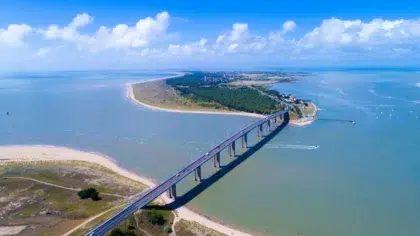
Noirmoutier
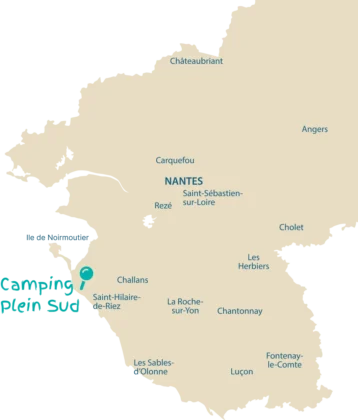
Just ten kilometers from the Plein Sud campsite in St-Jean-de-Monts is the island known as “l’île aux mimosas“, better known as the island of Noirmoutier. Although the island doesn’t have a title, it’s well worth a visit!
Read more
In fact, it’s an ideal place to stop and enjoy the beauty of the countryside, but also to discover its heritage, its castle, its typical architecture, its mills and its specialties (salt, potatoes, oysters).
Apremont
Situated on a rocky outcrop just 30 minutes from the campsite, the “little town of character” of Apremont is the ideal stop-off point to discover one of the most beautiful châteaux in the Vendée, the Château d’Apremont. This monument combines medieval and Renaissance styles.
Mallièvre
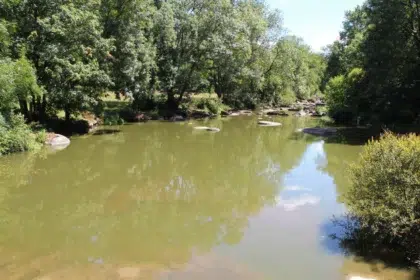
Discover the 16th-century weaving village of Mallièvre, on the banks of the Sèvre Nantaise, less than 10 kilometers from Le Puy du fou.
Vouvant
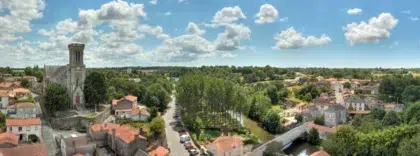
Vouvant, one of France’s most beautiful villages, is home to many legends, including that of the fairy Mélusine. She is said to have built, with the help of magic and men, some of the village’s most emblematic buildings, such as theRomanesque church of Sainte-Marie, the Tour Mélusine, a vestige of the château de Lusignan, and Mélusine’s house.
Read more
In addition to its remarkable architectural heritage, Vouvant is also a village of artists, with no fewer than 15 studios and art galleries to discover.
Fontenay le Comte
Classified as a Ville d’art et d’histoire, Fontenay le Comte is home to some real architectural treasures dating back to the Renaissance period, which lovers of fine stonework are sure to appreciate! Among them, of course, is the Châteaux de Terre-Neuve, built in the 16th century and home to such great names as the Duc de Sully and Agrippa d’Aubigné.
Read more
During a stroll to discover the town’s history, visitors will have the opportunity to contemplate Fontenay-le-Comte’s rich architectural heritage, including its emblematic Quatre-Rias fountain, arcaded houses and private mansions such as Maison Billaud, Hôtel de la Sénéchaussée, Hôtel Grimouard and Maison Beaux-Esprits.
Faymoreau
The former mining village of Faymoreau gave rise to a workers’ housing estate, distinguished by its distinctive architecture. Today, this 130-year mining past can be discovered on a stroll through the village and its various districts, as well as at the Centre Minier de Faymoreau.
Pouzauges
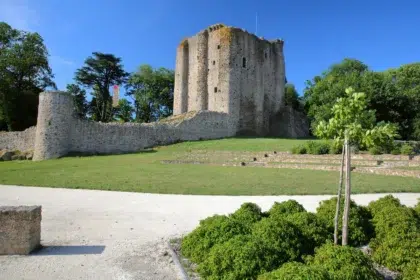
Just 20 minutes from the Puy du fou park, Pouzauges offers lovers of fine stonework and history the chance to discover the medieval character of the town center and its château, as well as the château de Saint-Mesmin (10 km away).
Read more
Family vacationers can also take an interesting tour of the Terrier Marteau twin mills and mini-farm.
Foussais Payré
To the east of the Mervent forest, 9 km from Vouvant, lies the village of Foussais-Payré, known for its remarkable Romanesque and Renaissance heritage. Indeed, its history has been marked by an economic boom thanks to the textile trade in the 16th century, which led to the construction of numerous buildings.
Read more
From this prosperous period in Foussais-Payré, you can still admire the house of merchant François Laurens, the Grand Logis, the Auberge Sainte-Catherine and the Halles on the Place de la Boule d’Or.
Nieul sur l’Autise
In the extreme south-east of the Vendée, 13 kilometers east of Fontenay-le-Comte, the “Petite cité de caractère” is distinguished by the presence of theAbbey of Nieul-sur-l’Autise (Saint-Vincent). Built in the 11th century, it was grantedRoyal Abbey status under the reign of Eleanor of Aquitaine.