The Vendée and its gastronomy
La Bonnotte
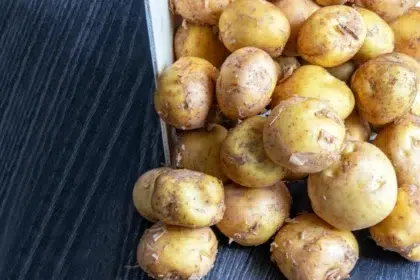
Bonnotte is the emblematic potato of Noirmoutier. It is grown only on the
Read more
Small, round, with firm, tender but very fragile flesh, so it should be eaten very quickly. Its particular taste is said to come from the iodine in seaweed. For the past 15 years, Noirmoutrins have been celebrating this famous potato with the Festival de la Bonnotte. Young farmers offer events such as old-fashioned harvesting in the field, a country-style dinner in local colors, etc.
Le Préfou
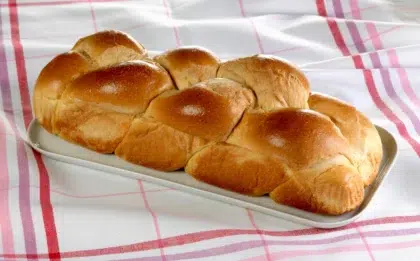
A speciality of the Vendée, préfou is an aperitif bread generously topped with garlic butter.
La Trouspinette
Is a typical Vendée aperitif made with blackthorn (wild blackthorn). It can be compared to walnut liqueur.
La Mogette
An emblematic food of the Vendée region, the mogette (white bean) was awarded the European PGI label on October 09, 2010, guaranteeing protection of the “Mogette de Vendée” denomination throughout the European Union. Connoisseurs enjoy it toasted, on bread toasts rubbed with a clove of garlic, buttered and covered with hot mogettes.
Read more
Jambon Vendéen
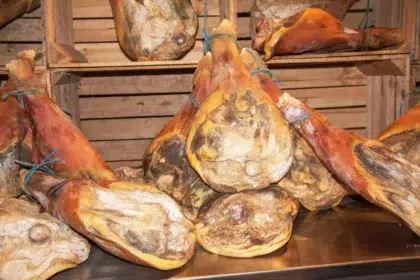
Jamon de Vendée is a raw ham hand-rubbed with dry salt, basted with wine brandy and sprinkled with natural spices and aromatics such as cinnamon, pepper, thyme and bay leaf. Wrapped in a cloth or food-grade bag and pressed between two boards, giving it a parallelepiped shape. Unlike most cured hams, the drying phase is short, as the ham is pressed. Vendée ham goes perfectly with mogette. Since October 2014, Vendée ham has benefited from the Protected Geographical Indication (PGI).
La Salicorne
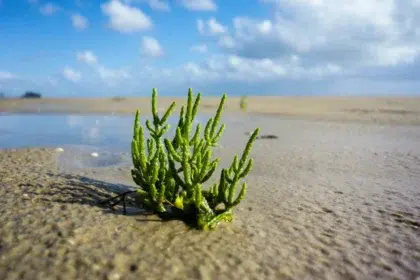
Glasswort is a small, fleshy wild plant with leafless stems found around salt marshes. Prepared and preserved like gherkins, it can be eaten raw, plain or in vinaigrette as a condiment or vegetable.
La Brioche Vendéenne
Brioche is the pride and joy of the Vendée. Sweet and very fragrant, either with brandy, orange blossom water or a mixture of the two. Apart from the Easter period, brioche vendéenne is made for major family celebrations. Gâche, brioche’s little sister, is also a Viennese pastry. Particularly made at Easter, the recipe for gâche differs somewhat from that for brioche: more sugar, just as much butter and, above all, an addition of crème fraîche… which makes it denser. Brioches and gâche de Vendée are now protected by a PGI (Protected Geographical Indication).
Le Fion
This traditional pastry was made at Easter by sailors’ wives. Fion Vendéen is a fragrant egg flan.
Les Caillebottes
Caillebotte is simply milk curdled with rennet, then served ultra-chilled with whatever you like as a garnish. They’re best enjoyed chilled.
In the past, Chardonnette flowers (a wild artichoke found in the dunes around St Jean de Monts and St Gilles Croix de Vie) were used to curdle milk.
The Fiefs Vendéens and Beer
Fiefs Vendéens is a wine appellation whose wines are produced in the Loire vineyards in western France, more precisely in the Nantes wine-growing region. Its terroir benefits from a temperate oceanic climate and schist, granite and silt soils.
The name “Fiefs Vendéens” first appeared in 1965, designating an appellation d’origine simple (AOS), then a “vin de pays délimité” designation in 1973. It was retained when the appellation became a “Vin Délimité de Qualité Supérieure”. From the 2011 harvest, Chantonnay terroirs join Mareuil sur Lay, Brem sur Mer, Vix and Pissotte in the appellation d’origine contrôlée (AOC).
Read more
Mélusine: 6.5%vol – a blond beer flavoured with honey and angelica
Love & Flower: 4.2%vol – a white beer flavoured with flower petals and fine hops
Puy D’Enfer : 8.5%vol – a triple ale flavored with a hint of coriander, hops and a selection of barley malts.
Cervoise: 6.5%vol – a red ale flavored with myrtle, generously malted and hopped.
Discover other craft beers on their brewery website.
La Sardine
Saint Gilles Croix de Vie is the leading Atlantic fishing port for sardines. Over 2,500 tonnes of sardines are landed each year for canning and canning. In 2000, Saint Gilles Croix de Vie sardines were awarded the “Label Rouge”, the first wild fish to receive such a distinction. Another local star is the pink shrimp or “Rose de St Gilles”. The pink shrimp’s peak season runs from late November to February.
Bouchot Mussels
The Baie de l’Aiguillon, a major shellfish-growing area, owes its reputation to the mussels raised on bouchots (oak stakes planted in the water). Bouchot mussels are distinguished by their yellow flesh and black, fairly hard shell, with a pronounced taste.
Atlantic Oysters
Three basins (Baie de Bourgneuf – Noirmoutier, Talmont Saint Hilaire and Baie de l’Aiguillon) have become oyster-farming centers: places where oysters are produced. A total of 10,000 tonnes of oysters are produced every year over a stretch of almost 80 km.
Read more
Fleur de Sel “The White Gold of the Salt Marshes
Rare and noble, Fleur de sel de l’île de Noirmoutier has a light violet fragrance and is exceptionally mild. Climatic and geological conditions must come together to obtain maximum saturation of sodium chloride in seawater. Harvesting takes place from May to September.
All you have to do is bring the salt, the “white gold”, to the edge of the eyelet using the traditional large, flat rake known as a “simoussi”. Gently picked and sorted by the saunier, it is then placed in a basket to dry naturally, preserving its richness in magnesium and trace elements.